


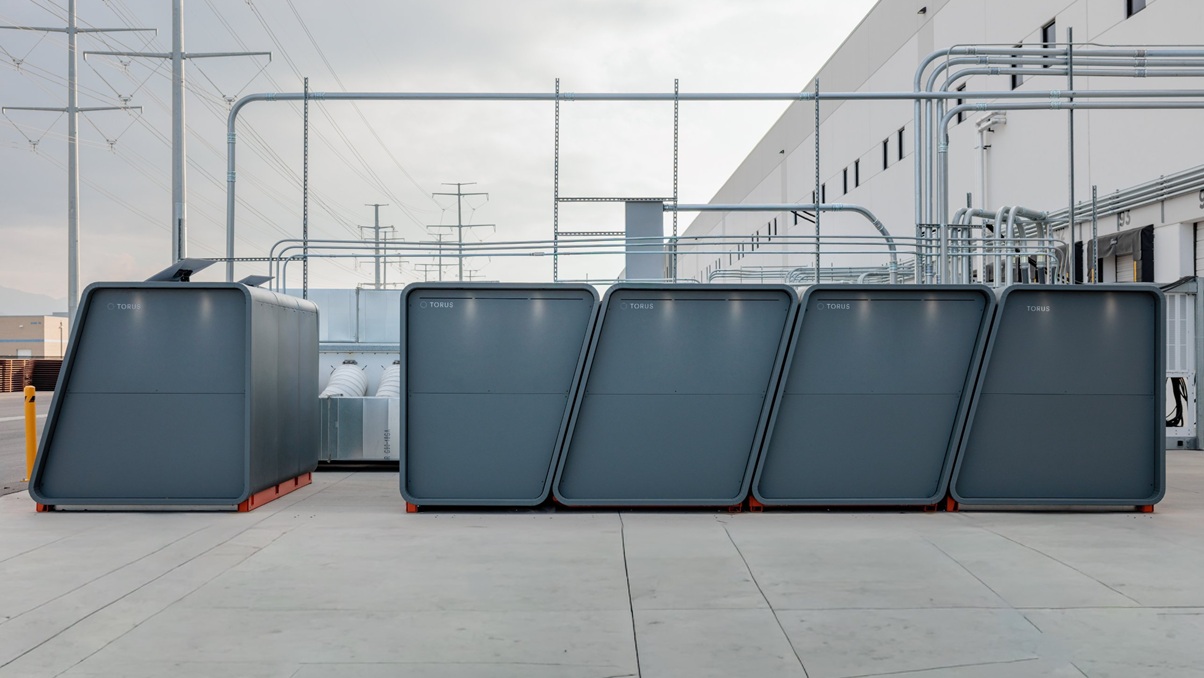
Securing the power to meet AI demand is the biggest bottleneck today, and it is one Torus has spent years solving. That bottleneck is constrained power and capacity, not building new generation. Torus’s technology unlocks unused grid capacity that sits between substations and existing commercial and industrial buildings by using existing interconnections. Every Foundry is paired with Torus Reserve, the company’s energy storage and management product. Reserve provides grid-enhancing technologies, including inertial-based firm power, grid flexibility with load curtailment capabilities, and ramp-rate support, all delivered through load-shaping recipes: predefined controls that govern how power is dispatched. These capabilities are important for AI compute infrastructure in shaping loads to manage demand, supporting grid stability, and ramping power in milliseconds. The result is distributed edge compute for the enterprise that takes advantage of existing grid interconnections and is online in 12–16 weeks from contract to token.
“The industry has been trying to solve AI’s power problem by building net-new infrastructure, which causes costs to potentially rise and takes years to bring compute online,” said Nate Walkingshaw, CEO and Founder of Torus. “Inference doesn’t have to wait. We’ve spent years learning how to make the grid more affordable, flexible, resilient, and intelligent, and Foundry applies that to compute: capacity in weeks, with power that’s already available. Most providers are bringing power to the chips. Foundry brings the chips to power.”
The result reflects a simple premise behind Torus’s work: much of America’s energy challenge is a capacity problem before it is a generation problem. The grid has unused capacity at many sites today, and Torus systems make that capacity usable.
Inference compute works differently. It runs continuously, serves users in real time, and benefits from being distributed closer to where demand is. This difference is pulling more compute toward on-premises and edge sites, and inference providers need capacity they can deploy, in more places, sooner. Foundry is built for that: distributed, smaller sites, deployed faster, on power that is already available. Enterprise customers want security, IP protection, and control over where their workloads run. Foundry’s design gives them that, in ways centralized capacity can be harder to match.
Foundry at-a-glance
- From contract to running AI workloads in 12–16 weeks. Foundry is prefabricated and modular, at 1–20 MW per site, with no building construction required. The smallest system is roughly the size of a small cargo van.
- No new grid infrastructure. Foundry is installed behind the meter, using available headroom, or available electricity, at individual transformers. It adds steady, high-load-factor demand without requiring infrastructure upgrades that often lead to rate increases, or affecting grid reliability.
- Full stack, one provider. Fiber to site, chiller to coolant distribution unit, grid to rack: Torus vertically integrates the entire stack, from Torus Reserve for load shaping and redundancy, to Torus Foundry for inference compute, to Torus Protect for integrated networking and security. Every deployment is turnkey, with ongoing operations and maintenance provided by Torus.
- Fastest path to token. Foundry units are prefabricated at GigaOne, Torus’s Salt Lake City manufacturing facility. Prefabrication accelerates the time to deploy by eliminating construction time at the deployment site. Site prep takes about a week, and installation and commissioning take one to two days.
- More compute on the same interconnection. Integrated inertial flywheel and battery storage and management cover demand peaks so more compute fits on an existing interconnection. During grid outages, it provides backup power.
- Made in Utah. Foundry is designed, engineered, and manufactured in Utah by Torus’s team of nearly 400 employees at GigaOne, with key components built in-house.
Multiple ways to deploy Foundry
Torus is launching Foundry with its first customers, Hydra Host and another AI cloud provider. Foundry is available in the following three models:
- Strategic: Powered shell includes power and enclosure, without GPUs.
- Partner: Turnkey bare metal unit includes power, enclosure, and GPUs.
- Direct: Sovereign inference capacity provided directly to enterprise customers. Single tenant hardware is allocated exclusively to a company’s workload.
Torus Foundry has thousands of GPUs deployed today, with plans to have more than 47,000 GPUs deployed in Foundry units by the end of 2027.