


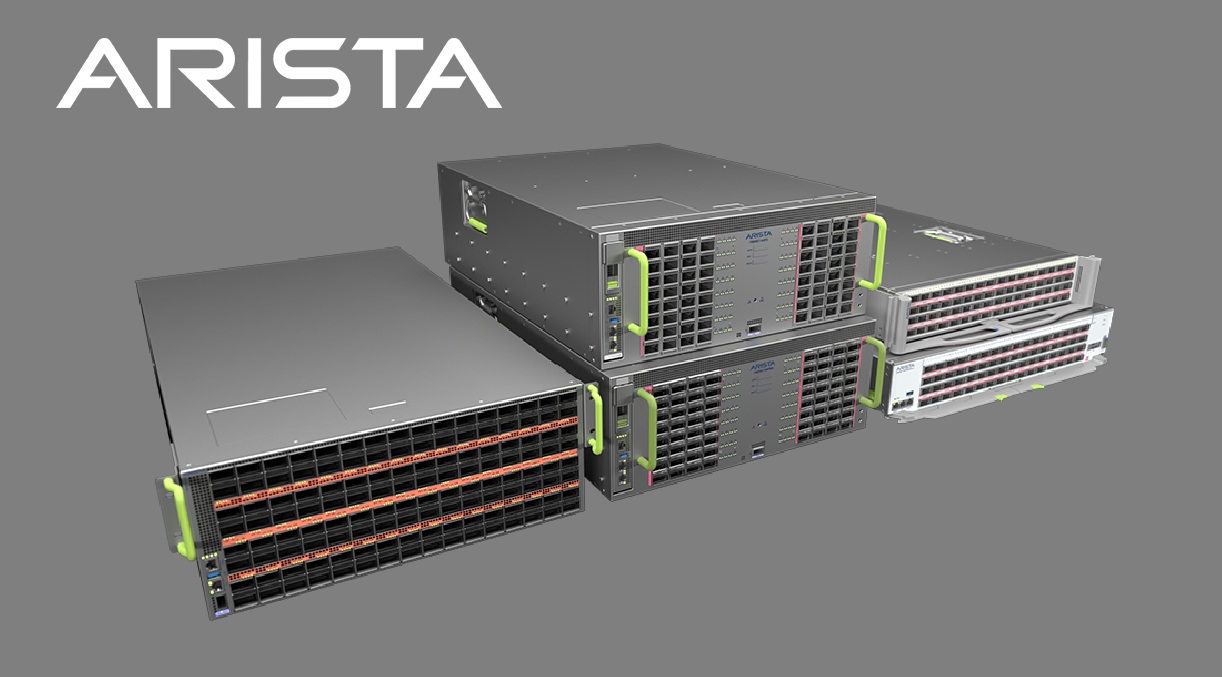
Arista Networks announced its open Ethernet rack-scale portfolio to power high-density scale-up and scale-out AI infrastructure. Engineered in partnership with leading compute technology companies such as AMD, Arm, Broadcom, d-Matrix, Meta, Microsoft, and Qualcomm, this effort leverages the Ethernet for Scale-up Networks (ESUN) initiative. With this set of platforms, Arista extends Ethernet into scale-up domains with liquid-cooled racks built for extreme density, power, and thermal demands, supporting up to 144 accelerators per rack and even more via cross-rack architecture. The result is an open, standards-based alternative to proprietary compute islands, enabling cloud titan operators to scale AI infrastructure with their preferred architecture.
“The network in the AI era is no longer just an independent pipe between servers. It’s now a tightly integrated rack-scale backplane that is essential to maximizing compute,” said Tyson Lamoreaux, Senior Vice President, Cloud and AI Networking at Arista Networks. “Arista is delivering an open, Ethernet-based framework for both scale-up and scale-out fabrics. By combining liquid cooling solutions with the choice of Arista EOS or open NOS, we empower cloud titans and enterprise innovators to scale heterogeneous compute and optimize their token economics without proprietary lock-in.”
Innovative Rack Scale-Up Designs
As AI models expand, the demand for tightly coupled communication across vast accelerator pools has outpaced the limits of local PCIe and proprietary interconnects. In response, Arista is introducing Etherlink SU-144, an Ethernet-based scale-up architecture that expands unified computing domains up to 144 accelerators (XPUs) in a single-hop network and scales to 1,024 XPUs through cross-rack topologies. Arista is pioneering Ethernet-based scale-up across three physical form factors, giving operators the flexibility to optimize for any accelerator’s needs.
- Orthogonal Chassis: A single-hop, single-rack architecture purpose-built for extreme bandwidth and density in intensive AI training and inference workloads, offering 100–400kW liquid cooling support.
- Cabled Backplane: Combines a high-density cabled backplane with a modular, highly serviceable rack structure optimized for signal integrity, performance, and long-term operational efficiency.
- Cross-Rack System: Delivers a fully modular standalone fabric, giving operators maximum flexibility to expand and adapt to future generations of scale-up acceleration via flexible interconnection across multiple racks.
Rack-Scale Architectures for Scale-Out Fabrics
Arista is also introducing rack-scale open Ethernet-based, heterogeneous scale-out networking solutions designed for extensibility and flexibility while supporting a variety of scale-up protocols. Built on a common Netdi foundation, customers get full operational consistency whether running Arista EOS or an open Network Operating System (NOS). The scale-out fabric incorporates advanced Ultra Ethernet Consortium (UEC) standards, Multipath Reliable Connection (MRC) fabric resiliency, multi-plane routing, and intelligent Dynamic Load Balancing (DLB) and Cluster Load Balancing (CLB) to optimize job completion times and token generation efficiency.
Rack designs feature multiple liquid-cooled 7060XE7 switches (102.4 Tbps capacity per switch), fiber patch panels, integrated liquid-cooling manifolds, drip trays with active leak detection, rack management controllers, and power shelves with Backup Battery Units (BBU).
Density Quadruples with Next-Generation Optics
Arista’s rack-scale solution features full integration of switches, optics, liquid cooling, and rack control, scaling to higher rack capacity with next-generation optics such as XPO and open CPO/NPO. Compared to today’s OSFP-based switches, which deliver 1.6 Pb/s per rack, next-generation optics increases that to 6.5 Pb/s per rack. This massive densification translates to nearly a 50% reduction in the overall data center footprint, resulting in significant time and financial savings.